Coronavirus Live Updates: U.S. Daily Deaths Exceed 1,000 - The New York Times
Coronavirus Live Updates: U.S. Daily Deaths Exceed 1,000 - The New York Times |
- Coronavirus Live Updates: U.S. Daily Deaths Exceed 1,000 - The New York Times
- Coronavirus (COVID-19) Update: Daily Roundup July 21, 2020 - FDA.gov
- Coronavirus Live News and Updates - The New York Times
- UK coronavirus vaccine shows early promise: Live updates - Al Jazeera English
| Coronavirus Live Updates: U.S. Daily Deaths Exceed 1,000 - The New York Times Posted: 22 Jul 2020 04:22 AM PDT  Here's what you need to know:Image  For the first time, Trump urges Americans to wear masks.The daily death total in the United States exceeded 1,000 for the first time in weeks on Tuesday, as the Centers for Disease Control and Prevention said there were likely far more infections than have been reported. The news came as President Trump abandoned his consistently rosy forecasts and told reporters during his first coronavirus briefing since April that the outbreak would probably "get worse before it gets better." Having previously described recent outbreaks around the country as just "embers" of the virus, Mr. Trump conceded that there were now "big fires," particularly in Florida and elsewhere across the South and West. He also reversed his past resistance to masks, for the first time imploring Americans to wear them and acknowledging that "they have an impact." His comments came as one of his primary arguments for optimism — what had been a descending death toll, even as overall cases sharply rose — showed more signs of crumbling. The 1,120 deaths reported on Tuesday were the highest total since May 29, excepting two days in late June when large numbers of deaths were reported from unknown dates, according to a New York Times database. Video transcript transcript Trump: Pandemic 'Will Get Worse before It Gets Better'President Trump resumed his daily virus briefings on Tuesday and admitted that the coronavirus pandemic will probably get worse before it gets better.
 The seven-day average of deaths in the United States reached 810 on Tuesday, up from an average of about 475 in early July, though still far below the country's April peak of 2,232. Public health experts have warned for weeks that deaths would trail new cases by about a month and case counts have risen substantially since mid-June, when states began lifting stay-at-home orders and reopening businesses. There were 65,449 new cases on Tuesday. But the number of people infected with the coronavirus in different parts of the United States has been anywhere from two to 13 times higher than the reported rates for those regions, according to data released Tuesday by the C.D.C. "These data continue to show that the number of people who have been infected with the virus that causes Covid-19 far exceeds the number of reported cases," Dr. Fiona Havers, the C.D.C. researcher who led the study, said in an email. "Many of these people likely had no symptoms or mild illness and may have had no idea that they were infected." Republicans squabble over what to include in the next round of pandemic relief.Video transcript transcript McConnell Lays Out Proposal for Next Stimulus BillRepublicans are looking into the next round of virus relief, which could include money for schools, funding for the federal loan program for small businesses and direct payments to families.
 When millions of Americans began losing their jobs in March, the federal government stepped in with a life preserver: $600 a week in extra unemployment benefits. That life preserver will disappear within days if Congress does not act to extend it. Republican leaders labored on Tuesday to avert a party revolt over the next round of coronavirus aid, announcing that they planned to provide $105 billion for schools, direct payments to American families and more aid for struggling small businesses. Even as Senator Mitch McConnell of Kentucky, the majority leader, divulged details of his emerging plan, which is expected to be worth roughly $1 trillion, President Trump had yet to sign on and Republicans remained deeply divided over several key elements. Ahead of what are expected to be difficult negotiations with Democrats, Senate Republicans and White House officials were fighting over how much money to devote to testing and to the federal health agencies on the front lines of the virus response; whether to include a payroll tax cut that Mr. Trump has demanded; and how to address the expiration of the enhanced unemployment benefits at the end of the month. Top Republican officials privately cautioned that the coming negotiation was likely to stretch into August, leaving tens of millions of unemployed Americans without extra help, potentially prompting a wave of evictions and further damaging the economy. On Tuesday, Mr. Trump offered a positive assessment of the economy: "We are in a pandemic, and yet we are producing tremendous numbers of jobs," he said during his virus-focused news conference. While it is true that nearly five million positions were brought back in June, over all the United States is still down about 14.7 million jobs since February. Diane von Furstenberg's brand is left exposed by the pandemic.The effects of the pandemic, which has forced retail chains such as Neiman Marcus and J.C. Penney as well as companies like J.Crew into bankruptcy, has reached the designer sector. And Diane von Furstenberg, the inventor of the wrap dress and as the 13-year head of the Council of Fashion Designers of America, is at risk of becoming the most recognizable example of its crisis. As the pandemic began to hit the retail sector, DVF's problems grew. In January, as the virus forced a lockdown in China, the company began to postpone payments to vendors, struggling with a major loss of revenue from Chinese consumers, who accounted for 20 percent of the brand's global sales. As the virus crept across Europe, things worsened, and by early June, DVF reportedly owed more than $10 million in store rent and millions more to vendors. Within four months, the British and French operations of Ms. von Furstenberg's company had done the European equivalent of filing for Chapter 11 bankruptcy. Just over 60 percent of the corporate and retail staff in the United States, Britain and France was laid off, creditors were complaining vociferously about unpaid bills, and Ms. von Furstenberg was making plans to close 18 of her 19 remaining directly operated U.S. stores. DVF's physical existence in the United States will be limited to the ground floor of its headquarters in the meatpacking district. Global roundup The banquet to celebrate this year's Nobel Prize winners has been canceled.The Nobel Prizes will still be awarded in early October, but the annual banquet in Stockholm to celebrate the winners has been canceled because of the pandemic, the Nobel Foundation announced Tuesday. The event on Dec. 10 is usually attended by Sweden's royal family and features an elaborate menu. Prize winners and their guests and families usually gather in Stockholm and Oslo in December for a week of events, but the celebrations this year will "take on new forms" to account for social distancing, the foundation said. "We will pay different attention to the prize winners, their discoveries and works," Lars Heikensten, the chief executive of the Nobel Foundation, said in a statement. The banquet was last canceled in 1956, in a protest over the Soviet Union's invasion of Hungary. It was also canceled during the two world wars. In other news from around the world:
A fatal crash on a New York bay highlights concerns about a boating boom during the pandemic.A deadly crash of two jet skis on a bay off the Bronx underscored widespread concerns about boating safety as the pandemic has led to a boom of perilous activity on the water in New York City and across the country. The crash occurred sometime after nightfall on Monday, a New York Police Department spokesman said on Tuesday, leading to the deaths of two men who were thrown into Eastchester Bay. The operator of a private boat pulled both men from the water and rushed them to shore, the spokesman said, and they were taken to a medical center, where they were pronounced dead. Recreational boating accidents, including those involving personal watercraft, rose nationwide in the first six months of the year compared with the same period in 2019, according to the Coast Guard's office for boating safety. Nationwide, fatal boating accidents were up 19 percent in the first six months of the year, the Coast Guard said. In the Northeast region, which includes New York and the New England states, deadly boating incidents were up 400 percent. The increases in recreational boating accidents around the country follow several years of steady declines. Mariana O'Leary, a Coast Guard spokeswoman, said the service's personnel started to notice a jump in recreational boating accidents this year as the weather warmed up and people who had been stuck inside could finally venture out. "What could be a factor is the fact that people are trying to get out of their houses and their apartments, going a little stir crazy, and perhaps they don't have the experience they need," Ms. O'Leary said. It's time to put an end to doomscrolling.Bingeing on doom-and-gloom news can feel irresistible to those stuck at home with little else to do. Here are some ways to break the habit. Reporting was contributed by Peter Baker, Luke Broadwater, Emily Cochrane, Gillian Friedman, Vanessa Friedman, Michael Gold, Apoorva Mandavilli, Sapna Maheshwari, Tiffany May, Raphael Minder, Claire Moses, Steven Lee Myers, Derek M. Norman, Bhadra Sharma and Daniel Victor.  |
| Coronavirus (COVID-19) Update: Daily Roundup July 21, 2020 - FDA.gov Posted: 21 Jul 2020 03:25 PM PDT 
The U.S. Food and Drug Administration today announced the following actions taken in its ongoing response effort to the COVID-19 pandemic:
The FDA, an agency within the U.S. Department of Health and Human Services, protects the public health by assuring the safety, effectiveness, and security of human and veterinary drugs, vaccines and other biological products for human use, and medical devices. The agency also is responsible for the safety and security of our nation's food supply, cosmetics, dietary supplements, products that give off electronic radiation, and for regulating tobacco products. ### Inquiries
Related Information |
| Coronavirus Live News and Updates - The New York Times Posted: 19 Jul 2020 04:04 AM PDT Here's what you need to know:Image  As the science on masks' effectiveness mounts, so does the U.S. debate on mandates.As caseloads surge in many states, especially in the West and South, the debate over mask mandates continues, though evidence of their benefits has mounted substantially in recent months. President Trump, who first wore a mask in public on July 11, said in a Fox News interview with Chris Wallace broadcast on Sunday that he was a "believer" in masks, but that he would not support a nationwide mask mandate: "I leave it up to the governors." The consistent message from the White House that virus restrictions be made at the local level has led to a patchwork of policies. More than half the states have issued mask requirements, but with many Americans feeling that mask orders impinge on individual freedom, some governors are holding out. The issue dominated talk shows on Sunday.
Frustrated by White House inaction, some Republican governors are beginning to go their own way.Despairing over President Trump's failure to contain the pandemic and his refusal to promote clear public-health guidelines, prominent figures in the Republican Party have broken with the White House in recent days on how to respond to the virus. Some, concluding that the president may never play a constructive role in addressing the crisis, have decided that they must work around him, ignoring or even contradicting his pronouncements. Republican leaders have split with Mr. Trump over issues like the value of wearing a mask in public and of heeding the advice of health experts like Dr. Anthony S. Fauci, whom the president and some aides have subjected to caustic personal criticism. They appear to be spurred by several overlapping forces, including deteriorating conditions in their states, the president's seeming indifference to the problem, and the approach of a presidential election in which Mr. Trump is badly lagging his presumed Democratic challenger, Joseph R. Biden Jr., in the polls. Republican governors are now issuing orders that run counter to Mr. Trump's demands. Some have been holding late-night phone calls among themselves to trade ideas and grievances; they have sought out partners in the administration, including Vice President Mike Pence, who, despite echoing Mr. Trump in public, is seen by governors as being far more attentive to the disaster. "The president got bored with it," David Carney, an adviser to the Texas governor, Greg Abbott, a Republican, said of the pandemic. His boss instead directs his requests to Mr. Pence, with whom he speaks two to three times a week, Mr. Carney said. Europe thought it was ready. Pride was its downfall.When European health ministers met in February to discuss the novel coronavirus emerging in China, they commended their own health systems and promised to send aid to poor and developing countries. Barely a month later, the continent was overwhelmed. Officials once boastful about their preparedness were frantically trying to secure protective gear and materials for tests, as death rates soared in Britain, France, Spain, Italy and Belgium. Updated This was not supposed to happen. Many European leaders felt so secure after the last pandemic — the 2009 swine flu — that they scaled back stockpiles of equipment and faulted medical experts for overreacting. But their pandemic plans were built on a litany of miscalculations. Though European leaders boasted of the superiority of their world-class health systems, they had weakened them with a decade of cutbacks. When Covid-19 arrived, those systems were unable to test widely enough to see the peak coming. National stockpiles of medical supplies were revealed to exist mostly on paper, consisting in large part of "just in time" contracts with manufacturers in China. European planners overlooked the fact that a pandemic could disrupt those supply chains. Britain most embodies Europe's overconfidence. Prime Minister Boris Johnson was so certain of his country's forecasts about the virus, records and testimony show, that he delayed locking down until two weeks after British emergency rooms began to buckle under the strain. With the number of infections doubling every three days at the time, some scientists now say that locking down a week sooner might have saved 30,000 lives. Global roundup Health workers in Brazil may have infected the Indigenous people they were trying to help.Government health workers sent out to care for Indigenous people in Brazil appear to have been spreading the virus among them instead. More than 1,000 nurses and doctors with a health service known as Sesai, have tested positive for the virus as of early July. In at least six field offices, The New York Times found, the share of infected workers was above the Amazon region's average of 8 percent. The health workers were dispatched with neither adequate protective equipment nor access to enough tests. Their high infection rates suggests that "there were failures in the protection of health care workers at a critical moment, affecting teams that care for a highly vulnerable population," said Felipe Tavares of the Federal Fluminense University. More than 15,500 Indigenous Brazilians have been confirmed infected, including at least 10,889 living in protected territories, according to Instituto Socioambiental, a Brazilian nonprofit. It is not possible to determine with certainty how many cases were introduced by health care workers. Some Indigenous people may have brought the virus into their communities after traveling to cities for supplies and emergency government aid. Illegal miners and loggers may also have exposed some communities. In a statement, Sesai said reports that health workers had exposed Indigenous people to the virus were "inconclusive." It said its employees were outfitted with protective equipment. "All this planning and early research led to timely and efficient care that was delivered in villages," the statement said. Several Sesai workers who spoke to The Times on condition of anonymity, fearing retaliation, described an exceptionally challenging mission marked by poor guidance, mistrust from many Indigenous communities and a scarcity of tests. Enoque Taurepang, the coordinator of the Indigenous Council of Roraima, said doctors and nurses had been set up for failure. "You can't blame health professionals, because they didn't have the tools necessary to act," he said.
Testing delays are complicating efforts to slow the spread of the virus.As demand for coronavirus testing surges around the nation, laboratories that process samples have backlogs that have left anxious patients waiting days — and sometimes a week or more — for their results. Dr. Francis Collins, the director of the National Institutes of Health, acknowledged the dangers associated with such delays in an interview on the NBC program "Meet the Press." "The average test delay is too long," Dr. Collins said. "That really undercuts the value of the testing, because you do the testing to find out who's carrying the virus, and then quickly get them isolated so they don't spread it around. And it's very hard to make that work when there's a long delay built in." On the CBS program "Face the Nation," Dr. Scott Gottlieb, the former commissioner of the Food and Drug Administration, said that "once testing is delayed more than 48 hours, it becomes not very useful." The longer it takes for people to determine whether they've been infected, Dr. Gottlieb said, the more difficult it will be to curb the spread of disease and drive new-case numbers down. To speed turnaround times, Dr. Collins said, health officials are pushing for more point-of-care testing — "on the spot" assays designed to be done rapidly and easily without the need for specialized laboratory equipment or highly trained personnel. Some of these tests could be completed in a doctor's office, or perhaps even at home, in less than an hour. Simple, speedy tests could be a boon for institutions and communities that care for large numbers of vulnerable people, like nursing homes. A handful of point-of-care tests have been approved for emergency use by the F.D.A. "We need to invest a lot of money, and the government is willing to do so, in scaling those up," Dr. Collins said. "That's the kind of thing that I personally, along with many others in other parts of the government, are working on night and day to try to do a better job of." Several Chinese companies are using Uighur labor to make masks, a Times visual investigation finds.Video transcript transcript Wearing a Mask? It May Come From China's Controversial Labor ProgramOur visual investigation reveals that several Chinese companies are using Uighur labor from a contentious government program to produce P.P.E. during the pandemic. We track some of that equipment to the U.S. and around the world.
 As companies across China rush to produce personal protective equipment amid the pandemic, a New York Times visual investigation has found that some of them are using Uighur labor through a contentious government-sponsored program that experts say often puts people to work against their will. Uighurs are a largely Muslim ethnic minority primarily from the Xinjiang region of northwest China. The government promotes the labor transfer program, which sends Uighurs and other ethnic minorities into factory and service jobs, as a way to reduce poverty, but quotas on the number of workers put into the labor program and the penalties faced by those who refuse to cooperate mean that participation is often coerced. Now, that labor is part of the P.P.E. supply chain. According to China's National Medical Products Administration, only four companies in Xinjiang produced medical grade protective equipment before the pandemic. As of June 30, that number was 51. After reviewing state media reports and public records, The Times found that at least 17 of those companies participate in the labor transfer program. The companies produce equipment primarily for domestic use, but The Times identified several other companies outside Xinjiang that use Uighur labor and export globally. We traced a shipment of face masks to a medical supply company in the U.S. state of Georgia from a factory in China's Hubei Province, where more than 100 Uighur workers had been sent. The workers are required to learn Mandarin and pledge their loyalty to China at weekly flag-raising ceremonies. Watch the full visual investigation in the video above. U.S. ROUNDUP Mayor Eric Garcetti says Los Angeles is 'on the brink' of a new stay-at-home order.Mayor Eric Garcetti of Los Angeles said that the coronavirus was spreading in the city to the point where a new stay-at-home order would have to be issued. "We're on the brink of that," he said on the CNN program "State of the Union" on Sunday. He declined to be more specific about the timing or scope of a new order, except to say, "We have to be surgical, rather than a cleaver that would just shut everything down." He said he agreed that earlier restrictions had been relaxed too quickly. "Mayors often have no control over what reopens up and doesn't," he said. "That's either at a state or county level." But he added, "It's not just about what's open and closed, but it's also about what we do individually." Los Angeles County has recorded more than 153,000 cases so far, and the spread of the virus has been quickening across Southern California. "Cases have gone up, but we also have the most aggressive testing," the mayor. "We were the first city to offer tests to people without symptoms." In other news around the country:
Rising cases cut a painful path among the most vulnerable: Inside a Texas border town hospital.As the virus spreads out across the United States, it is bearing down on places that are most vulnerable to its devastation — among them the southernmost wedge of Texas, on the border with Mexico, which is experiencing a punishing surge in infection. In the Rio Grande Valley, more than a third of families live in poverty. Up to half of residents have no health insurance. More than 60 percent are diabetic or prediabetic. The rates of obesity and heart disease are among the nation's highest. And more than 90 percent of the population is Latino, a group that is dying from the virus at higher rates than white Americans are. "We knew that this was a time bomb," said Dr. Adolfo Kaplan, a local critical care physician. But in the early days of the pandemic, there were few infections in the valley. Many public health officials attributed that to lockdown orders. Then in May, Gov. Greg Abbott let them expire. "We knew that if the hospital was hit, it was going to be a disaster," said Dr. Kaplan, who works at DHR Health in Edinburg, Texas. "And that's what we are living through." The three facilities the hospital is using to treat patients with Covid-19 have been filled to capacity since the first week of July. At times, a dozen or more ambulances have waited outside for beds to become available. With 10,000 active infections in the region, public health officers estimate that hospitalizations could double within two weeks. "Our curve is a straight up trajectory right now," said Sherri Abendroth, the hospital's safety and emergency management coordinator. "There's no flattening. There's no relief." Tennessee bar owners are fighting orders to close down again.Coronavirus cases in Tennessee have been rising sharply since late June, especially in and around Memphis and Nashville, where county officials are reporting hundreds of new cases a day. Both cities have been trying to tamp down outbreaks by reintroducing some restrictions, but they have run into resistance from restaurant and bar owners in the bustling nightlife districts. Across the country, crowded night spots have been cited as especially problematic settings in a pandemic, where masks just get in the way and social distancing is the opposite of what the patrons are there for. But owners have bridled at being singled out for shutdowns. In Davidson County, which includes Nashville, four bars sued the city after bars were ordered to close through the end of July, while restaurants were allowed to stay open at 50 percent capacity. Nashville's mayor, John Cooper, acknowledged that the city's restrictions would be difficult to enforce "in a population that probably does include disease deniers." And he said there was only so much Nashville could do when surrounding counties had much laxer restrictions. In Shelby County, which includes Memphis, bars and "limited service" restaurants were ordered to close earlier this month while others were allowed to stay open. That sparked a fight with owners who say the "limited service" distinction — applied to establishments that get less than 50 percent of their revenue from food — is arbitrary and pointless. A hearing in the case is set for Monday. The plaintiffs say the closure rule simply pushes patrons from some restaurants to others without any appreciable public health benefit. The lead plaintiff, Jeannette Comans, who owns the Blind Bear cocktail bar, said she had just rehired and trained enough employees to be almost fully staffed — including adding people at the door to check patrons' temperatures and remind them about mask rules — when the new closure order was issued. "They left me with no choice" but to sue, she said of health officials. "I still have to pay rent, I still have to pay business insurance. My poor employees daily are like, 'What do we do?' And I'm like, 'I don't know.'" Trump calls Fauci 'a little bit of an alarmist,' the latest salvo of White House criticism.President Trump called Dr. Anthony S. Fauci, the nation's top infectious disease expert, an "alarmist" who provided faulty information in the early days of the coronavirus pandemic. His remarks, in an interview with Fox News that aired Sunday, were the latest public criticism from a White House that appears to be mounting a coordinated effort to discredit Dr. Fauci, on the record and off, and in presidential tweets. Administration officials deny doing so. "I don't know that he's a leaker," Mr. Trump said during the interview with Chris Wallace "He's a little bit of an alarmist. That's OK. A little bit of an alarmist." Mr. Trump said that Dr. Fauci had been against his decision to close the borders to travelers from China in January. That is not true: While Dr. Fauci was initially opposed to the idea on the grounds that a ban would prevent medical professionals from traveling to hard-hit areas, he supported the decision by the time it was made. Mr. Trump also said that Dr. Fauci had been against Americans wearing masks. Dr. Fauci has said that he does not regret urging Americans not to wear masks in the early days of the pandemic, referencing a severe shortage of protective gear for medical professionals. Dr. Francis Collins, the director of the National Institutes of Health, was asked on the NBC program "Meet the Press" whether anyone at the White House had asked him to demote or fire Dr. Fauci, whose agency is under Dr. Collins's supervision. "Nobody has asked me to do that and I find that concept unimaginable," Dr. Collins said. In the hourlong interview on Fox, Mr. Trump, whose administration made crucial missteps in handling the virus earlier this year, made several false claims on the government's response to the pandemic.
Mr. Biden, who has been critical of Mr. Trump's handling of the outbreak, said in a statement on Sunday: "In the middle of a pandemic that continues to worsen on his watch, President Trump is trying to keep money away from the public health measures that we know will keep us and our families safe. He even went on to attack the value of testing again in the same interview, perpetuating a terrible monthslong streak." "Mr. President, your ignorance isn't a virtue or a sign of your strength," Mr. Biden said. "It's undercutting our response to this unprecedented crisis at every turn and it's costing Americans their jobs and their lives." How to have a better backyard.We're all spending more time outdoors. Here's a few tips to take your tired backyard, stoop or balcony into a true escape. Reporting was contributed by Sarah Almukhtar, Manuela Andreoni, Ken Belson, Luke Broadwater, Alexander Burns, Letícia Casado, Choe Sang-Hun, Emily Cochrane, Melina Delkic, Maggie Haberman, Rebecca Halleck, Drew Jordan, Christoph Koettl, Ernesto Londoño, Jonathan Martin, Tiffany May, Raphael Minder, Elizabeth Preston, Roni Caryn Rabin, Natalie Reneau, Katie Rogers, Mitch Smith, Matina Stevis-Gridneff, Lucy Tompkins, Pranshu Verma, Haley Willis, Katherine Wu, Muyi Xiao, Ceylan Yeginsu and Karen Zraick.  |
| UK coronavirus vaccine shows early promise: Live updates - Al Jazeera English Posted: 20 Jul 2020 03:11 PM PDT
Here are the latest updates. Monday, July 2022:06 GMT - US coronavirus deaths, cases, hospitalisations continue to climbThe city of Chicago reimposed some coronavirus restrictions on Monday and the state of Florida reported more than 10,000 new cases for the sixth day in a row, as the coronavirus pandemic raged across the United States. New York state recorded only eight deaths on Sunday while the total number of people hospitalised for the disease fell to 716, the fewest since March 18, Governor Andrew Cuomo said. But metrics for the country as a whole have grown worse. Thirty-two states have reported record increases in COVID-19 cases in July while 15 states have reported record increases in deaths. Deaths, hospitalisations and rates of positive test results continue to climb with at least 15 states reporting record hospitalisations so far in July, according to a Reuters tally. Read more here. 21:44 GMT - In his most explicit endorsement of face masks to date, Trump tweets picture of himself wearing oneUnited States President Donald Trump on Monday for the first time tweeted a picture of himself wearing a mask and said it is the "patriotic" thing to do to help curb the spread of the coronavirus.
Trump has for months resisted wearing a mask in public but managed to do so during a tour of the Walter Reed Hospital two weeks ago. The picture tweeted by the president on Monday was taken during that trip and shows Trump wearing a mask decorated with a presidential seal. 20:25 GMT - Scaled-down hajj pilgrimage to start July 29: Saudi authoritiesThis year's hajj, which has been scaled back dramatically to include only around 1,000 Muslim pilgrims due to the coronavirus pandemic, will begin on July 29, Saudi authorities said Monday. "The stand of pilgrims on Mount Arafat, the peak of the hajj ritual, falls on Thursday," the official Saudi Press Agency cited the Supreme Court as saying, indicating that Wednesday would be the first day of the annual event. 19:35 GMT - New York cautiously reopens as coronavirus surges elsewhere in USNew York state reported the fewest hospitalisations from the coronavirus in four months on Monday just as New York City entered a new phase of reopening, but the progress was eclipsed by the rapid spread of COVID-19 elsewhere in the United States. 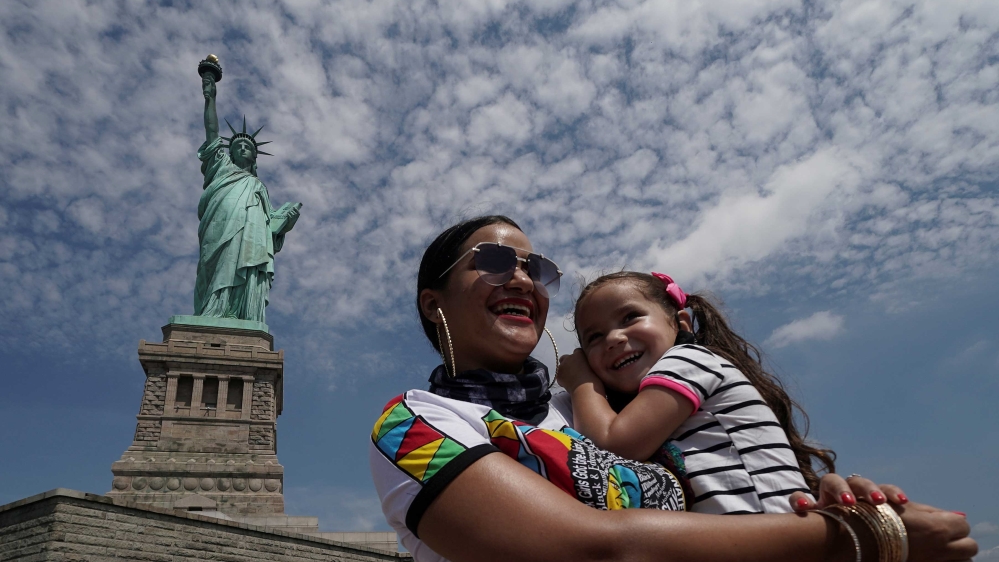 New York City, once the world epicentre of the pandemic, enters stage four of reopening after months of declining cases [Carlo Allegri/Reuters] The state recorded eight deaths on Sunday while the total number of people hospitalised for the disease fell to 716, the fewest since March 18, Governor Andrew Cuomo said. Cuomo called the figures "good news," although a Reuters analysis of data from the COVID Tracking Project showed cases rose to more than 5,000 in the past week for the first time since April, breaking a 13-week streak of declines. Read more here. 19:00 GMT - Spain's coronavirus rate triples in three weeks after lockdown easingThe prevalence of coronavirus in Spain has risen three-fold over the last three weeks as authorities struggle to contain a rash of fresh clusters, mainly in the Catalonia and Aragon regions, Health Ministry data showed on Monday. After registering thousands of cases and hundreds of deaths per day during an early April peak, Spain succeeded in slowing the number of new infections to a trickle. But since restrictions on movement were lifted and Spaniards relaxed back into daily life, some 201 new clusters have appeared, with heavy concentrations in and around the Catalan cities of Barcelona and Lleida. 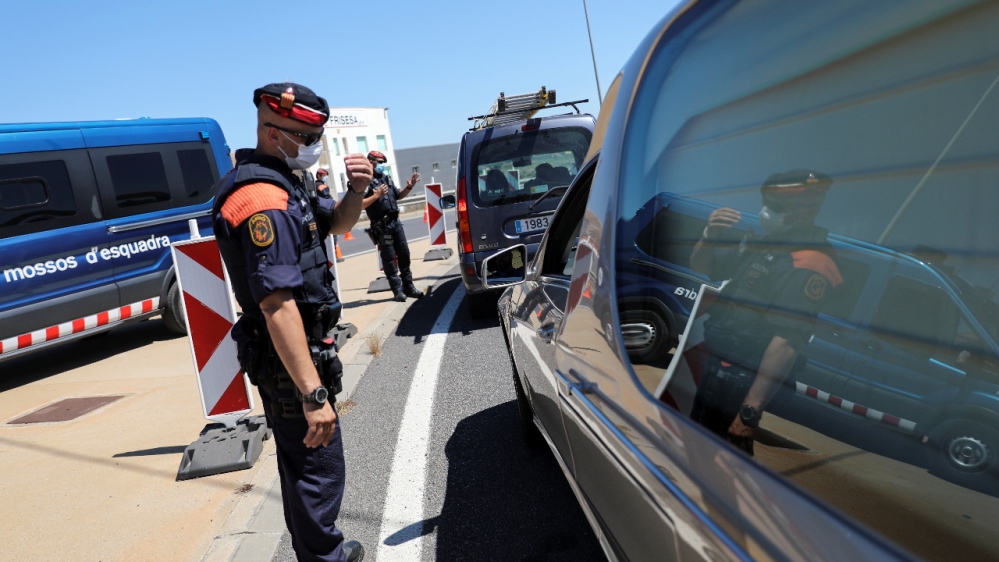 Over the weekend 4,581 new cases were recorded, bringing the total to 264,836, she added. More than 28,000 people have died [Nacho Doce/Reuters] The occurrence of the novel coronavirus has jumped from eight cases per 100,000 inhabitants at the end of June, when the country's state of emergency ended, to 27 per 100,000, deputy health emergency chief Maria Sierra told a news conference on Monday. "Where measures have been relaxed is where these clusters appear," Health Minister Salvador Illa said. "We're talking about gatherings of extended family and spaces associated with nightlife." 18:00 GMT - Trump says will resume coronavirus briefingsPresident Donald Trump said he will resume the White House briefings on the global coronavirus pandemic this week. Speaking to reporters in the Oval Office during a meeting with Republican leaders on additional stimulus measures, the president said the COVID-19 crisis is "flaring up all over the place" again, not just in the United States. "I do want people to understand this is a worldwide problem caused by China, but it's a worldwide problem. Countries are going through hell," he said. 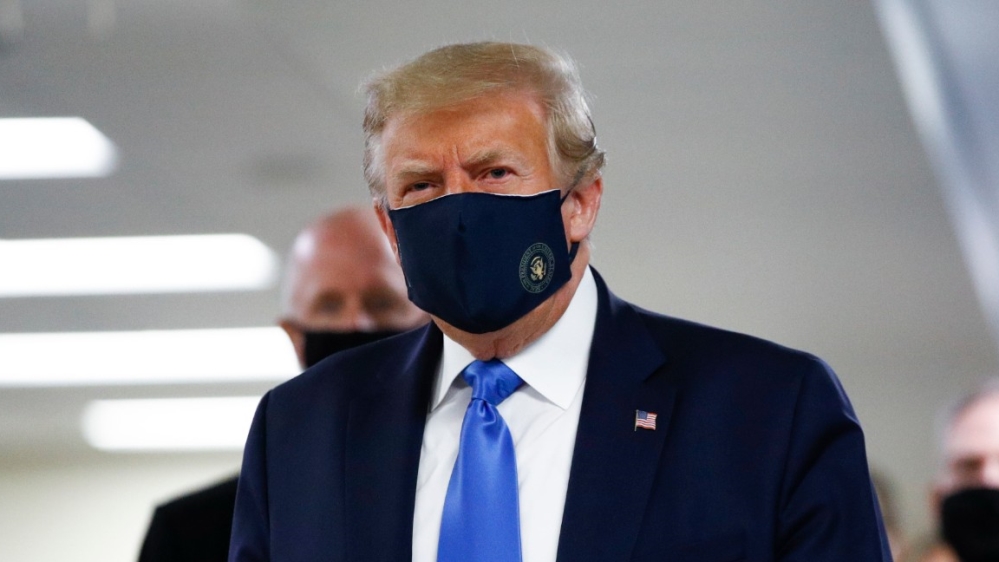 Trump said the briefings are "a great way to get the information out to the public" [Patrick Semansky/AP] Trump said the briefings are "a great way to get the information out to the public" [Patrick Semansky/AP]Still, Trump sounded an optimistic tone regarding the progress being made on potential vaccines and therapeutics, saying companies like Johnson & Johnson and others are getting close on both. Trump said he feels "pretty damn certain that they're going to have the vaccine, they're going to have therapeutics, and it's going to start taking place very shortly." 17:10 GMT - WHO 'very concerned' as COVID-19 spread speeds up in AfricaAfrican countries need urgent help to build up their health systems as coronavirus continues to spread rapidly, a senior World Health Organization (WHO) official warned. Although the number of cases in several countries is still low, the rate of increase has been very high last week, WHO emergency operations chief Mike Ryan said. "I am very concerned right now that we are beginning to see an acceleration of disease in Africa, and we need to take that very seriously," Ryan told a press briefing from Geneva. "Many of those countries exist in the midst of fragility and conflict." 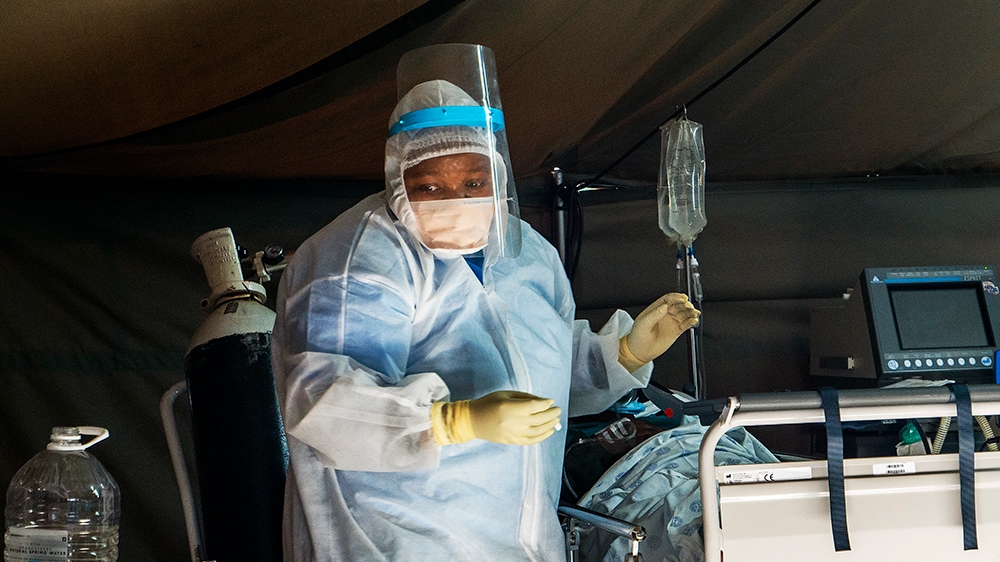 Only four countries have reported more coronavirus cases than South Africa [Jerome Delay/AP] Only four countries have reported more coronavirus cases than South Africa [Jerome Delay/AP]With more than 360,000 COVID-19 cases and more than 5,000 related deaths, South Africa has been hit the hardest and accounts for 61 per cent of Africa's pandemic burden. "South Africa may unfortunately be a precursor," he said. "It may be a warning for what will happen in the rest of Africa." 16:30 GMT - Bahamas introduces restrictions as cases riseBahamas will shut its borders to international flights and commercial vessels carrying passengers, the country's prime minister said. Flights from the UK, Canada and EU countries are exempted, Hubert Minnis said. The restrictions will come into effect on Wednesday. Bahamas has reported 153 cases and 11 deaths, according to a tally by Johns Hopkins University. 15:45 GMT - Indigenous people especially at risk from coronavirus, warns WHOIndigenous communities comprising half a million people around the world are especially vulnerable to the new coronavirus pandemic due to often poor living conditions, the World Health Organization (WHO) warned. Director General Tedros Adhanom Ghebreyesus said that as of July 6, there were more than 70,000 cases reported among indigenous peoples in the Americas, with over 2,000 deaths. "We do not have to wait for a vaccine. We have to save lives now," he told a virtual briefing from the UN agency's headquarters in Geneva. 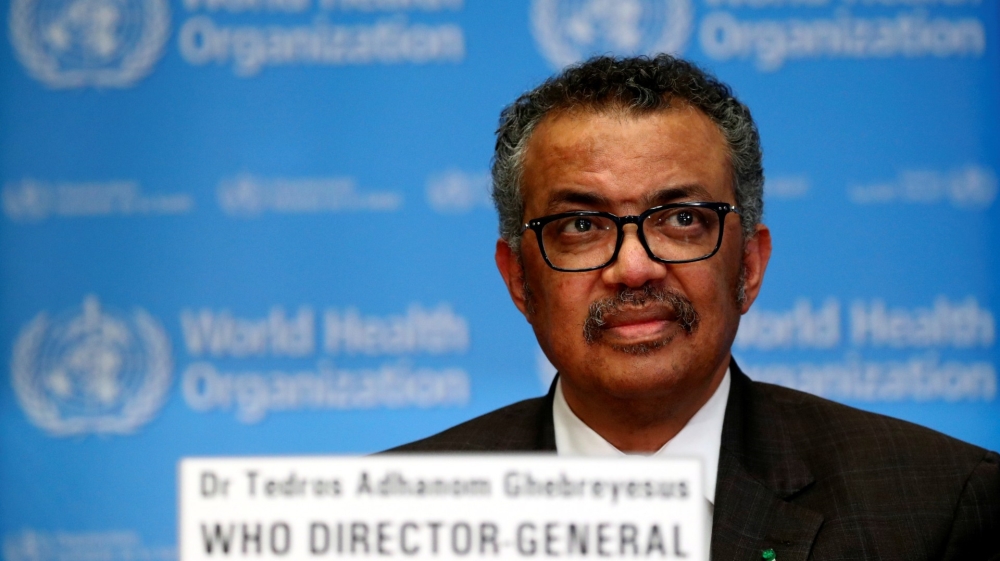 Tedros urged nations to take all necessary health precautions, with special emphasis on contact tracing, to try and curb the virus' spread [Denis Balibouse/Reuters] 15:05 GMT - Denmark to allow sailors stranded at sea to come ashoreDenmark said it will allow merchant sailors stranded on the high seas since the outbreak of the coronavirus to come ashore and be reunited with their friends and families. Since the outbreak of the virus, 200,000 seafarers have been stranded on merchant ships, some for more than a year, because travel restrictions have made it almost impossible to rotate crews. "While many Danes have used the corona crisis to spend more time with the family, many Danish sailors have had to do without family and friends for much longer than usual," Business Minister Simon Kollerup said.  Sailors will be granted visas to enter or travel through Denmark in controlled settings, the business ministry said, to allow them to embark or disembark ships in Denmark or neighbouring countries [Reuters] 14:00 GMT - UK coronavirus vaccine shows promiseScientists at Oxford University say their experimental coronavirus vaccine has been shown in an early trial to prompt a protective immune response in hundreds of people who got the shot. British researchers first began testing the vaccine in April in about 1,000 people, half of whom got the experimental vaccine. Such early trials are usually designed only to evaluate safety, but in this case experts were also looking to see what kind of immune response was provoked. 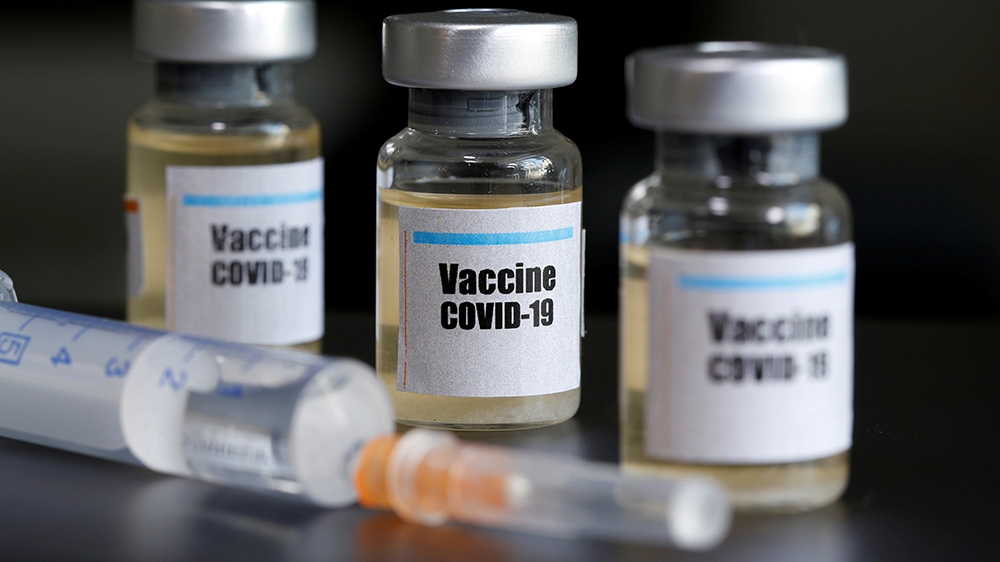 Numerous countries including Germany, France, the Netherlands, Italy, US. and the UK have all signed deals to receive hundreds of millions of doses of the vaccine [Dado Ruvic/Reuters] In research published Monday in the journal Lancet, scientists said that they found their experimental COVID-19 vaccine produced a dual immune response in people aged 18 to 55. "We are seeing good immune response in almost everybody," said Dr. Adrian Hill, director of the Jenner Institute at Oxford University. "What this vaccine does particularly well is trigger both arms of the immune system," he said. 13:40 GMT - Ballon d'Or 2020 scrapped because of COVID-19The Ballon d'Or will not be awarded this year for the first time in its 64-year history after the COVID-19 pandemic wreaked havoc on the football calendar, organisers France Football magazine said. The prestigious award, voted for by journalists, is an annual prize given to the best male footballer in the world since 1956. The women's Ballon d'Or was first awarded in 2018.  Barcelona's Lionel Messi has won the men's award a record six times - one more than long-time rival Cristiano Ronaldo [Alex Caparros/Getty] The 2019-20 season has been ravaged by the pandemic, with all the major European leagues suspending matches from March to June. International tournaments, such as the European Championship and Copa America, were also pushed back to 2021 due to the virus. 13:15 GMT -Hello, this is Hamza Mohamed in Doha taking over from my colleague Farah Najjar. 12:12 GMT - Russia says hoping to produce 200m vaccine doses this yearRussia hopes to complete trials of a vaccine in August and produce 200 million doses with foreign partners by the end of the year, the head of its sovereign wealth fund has said. The Russian Direct Investment Fund (RDIF), which manages some $10bn, is working with a government research institute on one of several vaccine projects in the country. RDIF chief executive Kirill Dmitriev said he hoped the project would receive permission next month to begin production, after the first phase of a vaccine trial was completed last week. "Immediately after that we are planning to begin mass production," Dmitriev said in a statement on Russia's state anti-coronavirus portal. "Mass production of this vaccine can stop the pandemic's potential 'second wave'," he said, adding that Russia would be in a position to produce 30 million doses of the vaccine by year's end, with "international partners across the world" joining in to bring the total to 200 million.
11:58 GMT - Greece tightens rules for foreign seasonal workersGreece introduced stricter rules for foreign seasonal workers after a recent spike in COVID-19 cases in the Balkans. Last year, more than 10,000 seasonal workers, mainly from Albania, Bulgaria and North Macedonia, were employed in Greece's agricultural sector. "Land workers that exit the country before August 4 will not be able to return until further notice," government spokesman Stelios Petsas told a news briefing. Seasonal workers were permitted into the country in early May under a three-month special licence. Petsas added that land entry to Greece will be allowed only via six northern border crossings to better control imported COVID-19 cases. 10:45 GMT - UK PM Johnson: We're not there yet on COVID-19 vaccineBritish Prime Minister Boris Johnson said he could not promise there would be a successful vaccine against COVID-19 developed by the end of this year, saying "we're not there yet" even as Britain lines up supplies. "To say that I'm 100 percent confident that we'll get a vaccine, this year or indeed next year, is alas, just an exaggeration. We're not there yet," Johnson said after Britain announced supply deals for two more vaccines under development 10:33 GMT - Cinemas in China begin to reopen after six-month closureSome cinemas in Chinese cities from Shanghai to Chengdu reopened after a six-month closure, raising hope that the world's second-largest movie market can start to recover from painful losses during the pandemic. Chinese authorities last week said they would allow cinemas in low-risk areas to resume operations in a restricted fashion, a long-awaited piece of news for a leisure industry that has seen many other venues revive recently. But many cities kept their cinemas shut on Monday as Beijing said they would leave the final decision on whether to open up to local authorities. 09:54 GMT - UK buying 90 million coronavirus vaccine dosesBritish officials say they have signed a deal to buy 90 million doses of experimental coronavirus vaccines being developed by the pharmaceutical giant Pfizer and others. The British government said in a statement that it had secured access to a vaccine candidate being developed by Pfizer and BioNTech, in addition to another experimental vaccine researched by Valneva. Britain had previously signed a deal with AstraZeneca to provide 100 million doses of the coronavirus vaccine being tested by Oxford University, which is expected to announce further results later on Monday. "Millions of people could be vaccinated against coronavirus," the government statement said, citing the three different vaccines it has now invested in.  Vaccines typically take years to develop and more than a dozen are in the early stages of testing globally [File: Getty Images] 09:42 GMT - Indonesia reports second-highest daily increase in deathsIndonesia reported its second-highest daily increase in coronavirus-related deaths with 96 fatalities, a day after registering a record daily jump in deaths, data presented by health ministry official Achmad Yurianto showed. The country also reported 1,693 new infections, taking the total to 88,214, the highest number in East or Southeast Asia, with a total of 4,239 deaths. 08:58 GMT - Hong Kong reports 73 new cases as local transmissions stay highHong Kong reported 73 new cases, including 66 that were locally transmitted, as new restrictions took effect and authorities warned there was no indication that the situation was coming under control. The global financial hub reported more than 100 cases on Sunday, a record number as Hong Kong leader Carrie Lam announced that non-essential civil servants must work from home. 08:44 GMT - Philippines reports 4 new deaths, 1,521 more infectionsThe Philippines' health ministry confirmed four new coronavirus deaths and 1,521 new cases, its fifth straight day of reporting over a thousand infections. In a bulletin, the ministry said total deaths have increased to 1,835 while confirmed cases have reached 69,898. 08:38 GMT - France says up to 500 virus clusters but no 'second wave' yetFrench authorities have reported 400 to 500 active coronavirus outbreak clusters but there are no signs of an imminent "second wave," Health Minister Olivier Veran said. Many of the current virus clusters involve abattoirs or other contained professional settings such as old age homes, he said. Others had resulted from family reunions during the summer holidays. "At this point we are very far from a second wave," Veran told Franceinfo radio, as face masks were made mandatory in all enclosed public spaces including shops, covered markets and administrative buildings. "The goal is not to worry people excessively, but to keep them on their guard," he said.
08:01 GMT - Russia reports almost 6,000 new infectionsRussia reported 5,940 new cases, pushing its total infection tally to 777,486, the fourth largest in the world. In a daily readout, officials said 85 people had died in the last 24 hours, bringing the official death toll to 12,427. 07:43 GMT - Synairgen's drug shows reduced risk of severe disease in COVID-19 patientsSynairgen Plc said its drug helped reduce the risk of developing severe diseases in hospitalised COVID-19 patients, according to data from a trial of more than 100 people in the United Kingdom. The trial, which used interferon beta, showed that patients who were given Synairgen's formulation had a 79 percent lower risk of developing severe disease compared to a placebo. Patients who received the drug, SNG001, were more than twice as likely to recover from COVID-19 as those on a placebo, the company said. 07:21 GMT - 14 died from likely COVID-19 complications in Egyptian prisons: HRWAt least 14 prisoners have died from likely COVID-19 complications in scantly-monitored outbreaks of the disease at Egyptian detention centres, Human Rights Watch has said. "At least 14 prisoners and detainees have died, most likely from Covid-19 complications, in 10 detention facilities as of July 15," the rights groups said in a statement. HRW based its report on witness accounts, leaked letters from prisons and reports by local rights groups. "Prisons had insufficient medical care and virtually no access to testing for the virus or symptom screening," it said. HRW noted that Egypt had released some 13,000 prisoners since February, but this was "insufficient to ease overcrowding in congested prisons and jails".  'Prisons had insufficient medical care and virtually no access to testing for the virus or symptom screening,' HRW said [File: Amr Abdallah Dalsh/Reuters] 'Prisons had insufficient medical care and virtually no access to testing for the virus or symptom screening,' HRW said [File: Amr Abdallah Dalsh/Reuters]07:05 GMT - India reports 40,000 new cases, a record daily surge in infectionsIndia reported 40,425 new cases of the coronavirus, a record high for the country. The new infections raised the country's total number of cases to 1,118,043, including 27,497 deaths. The ministry said late on Sunday that India's coronavirus fatality rate - currently at 2.49 percent - is "progressively falling" due to an effective containment strategy and aggressive testing. A country of 1.4 billion people, India has been conducting nearly 10,000 tests per million people. More than 300,000 samples are being tested daily now, compared to just a few hundred in March, according to the Indian Council of Medical Research, India's top medical research body. With a surge in infections in the past few weeks, local governments in India have been ordering focused lockdowns in high-risk areas.
07:01 GMT - Number of active cases in Pakistan continue to dropActive cases of the coronavirus continue to drop in Pakistan, where the government says it is testing fewer people because there has been a drop in the number of patients seeking treatment for COVID-19. On Sunday, at least 1,587 new cases of the virus were registered, taking the country's overall tally to 265,083 since its outbreak began in late February. Active cases, however, fell by 97, as the case increase was offset by recoveries. Active cases are now at 53,465, their lowest level since June 3. At least 31 deaths took the death toll to 5,689 on Sunday, the data showed. Hello, this is Farah Najjar taking over from my colleague Ted Regencia. 05:02 GMT - Malaysian PM to give update on COVID-19 situation
Malaysian Prime Minister Muhyiddin Yassin is expected to address the nation on Monday at 08:00 GMT to give an update on the country's coronavirus situation, according to one of his ministers. On Sunday, the country reported 15 new cases including four from abroad, and one death. More than 97 percent of COVID-19 patients in Malaysia have recovered. 04:39 GMT - Hong Kong banks shutter branches again new infectionsHSBC, Standard Chartered and other banks in Hong Kong closed branches or curtailed their working hours on Monday after a spike in the number of new coronavirus cases in the Asian financial hub, according to Reuters news agency. Hong Kong recorded more than 100 cases in 24 hours over the weekend, the most since the pandemic began in late January. The rise in cases took the tally close to 2,000 patients, 12 of whom have died. 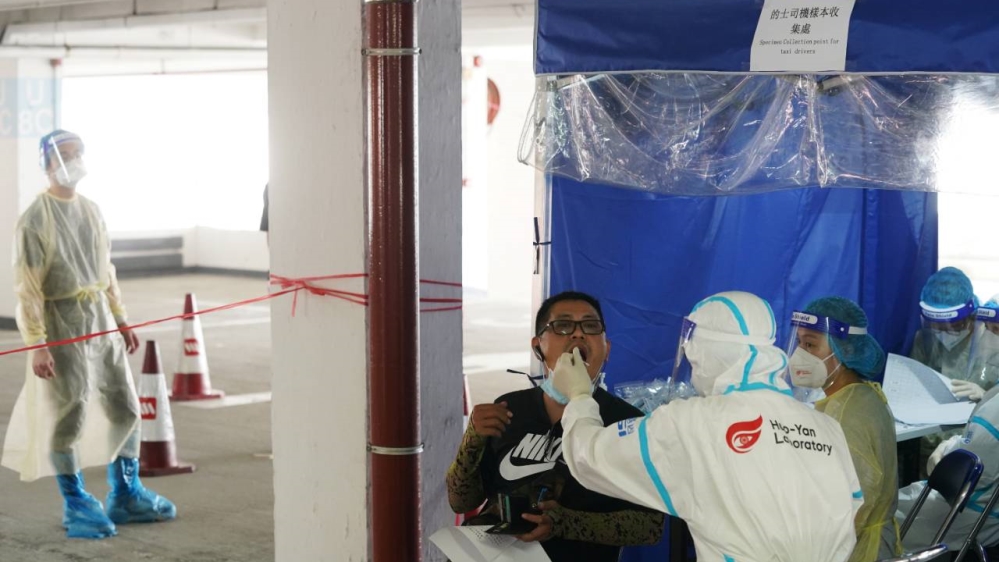 A medical worker in protective suit collects swab from a man to test for the coronavirus at a specimen collection point for taxi drivers in Hong Kong on Monday [Lam Yik/Reuters] 04:03 GMT - US state of Kentucky hits daily record of new casesA daily record of nearly 1,000 coronavirus cases has been reported in the US state of Kentucky, a spike that the governor said should be a "wake-up call" for the state's citizens to abide by mask and social distancing restrictions, according to AP news agency. Democratic Governor Andy Beshear announced in a news release there were 979 new cases reported on Sunday, including 30 involving children five-year-old or younger. The state has reported more than 23,000 cases and almost 700 deaths so far. 03:38 GMT - Cyprus raises concerns over spread of infection by migrantsCyprus's health minister says there is concern that coronavirus-infected migrants could be seeping through the ethnically divided island nation's porous ceasefire line, The Associated Press news agency reported. Minister Constantinos Ioannou on Sunday pointed to "a problem" after a number of migrants who recently crossed from the breakaway north to seek asylum in the internationally recognised south have tested positive for the coronavirus. Ioannou said the government had ordered two months ago that all migrants undergo testing for the virus before they enter reception centres for processing. At least eight Syrian migrants who crossed southward in the last week tested positive for the virus. 03:16 GMT - Majority of Japanese reject gov't tourism campaign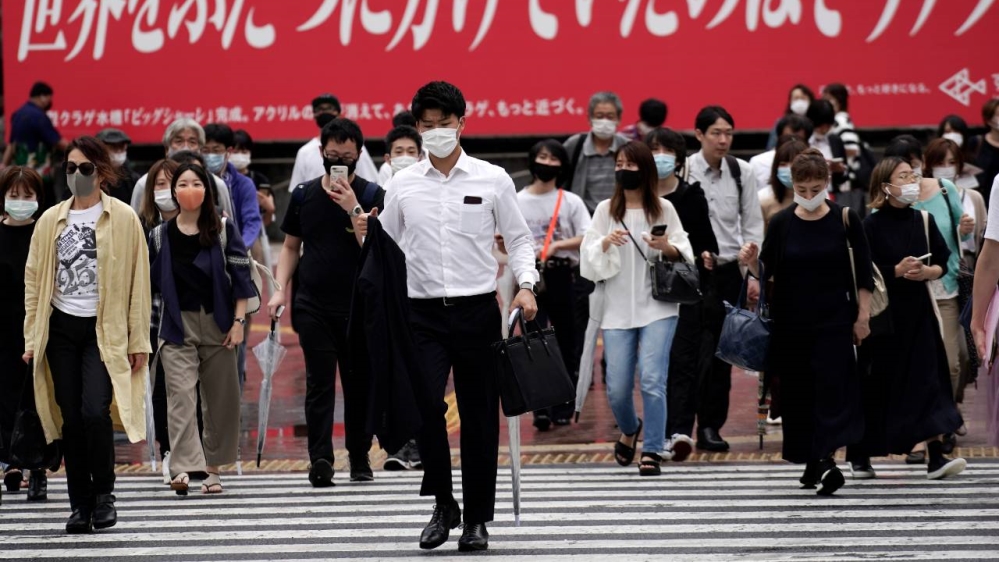 Broadcaster NHK said more than 500 new cases were reported nationally on Sunday, of which 188 were in Tokyo [Eugene Hoshiko/AP] Most people in Japan are against government plans to kick-start domestic tourism with a subsidised campaign, according to newspaper surveys published on Monday, as fears grow over the number of new coronavirus cases, particularly in Tokyo, according to Reuters news agency. The results highlight growing concerns that Prime Minister Shinzo Abe's $16bn "Go To" campaign, set to begin on Wednesday, could spread the virus to rural parts of the country where medical systems are fragile. Broadcaster NHK said more than 500 new cases were reported nationally on Sunday, of which 188 were in Tokyo - down by about 100 from the previous day but still well above levels seen when Abe's government in late May called an end to a state of emergency it had imposed to contain the virus. 02:58 GMT - More cases reported in China's XinjiangNumbers of coronavirus cases in Xinjiang's city of Urumqi continue to rise, with another 17 reported on Monday, bringing the total in China's latest outbreak to at least 47. Another five cases were brought from outside the country, the National Health Commission said. So far 83,682 cases, including 4,634 deaths, have been recorded. China had largely contained local transmission of the virus before the Urumqi outbreak and has taken swift action including a lockdown to bring it under control. 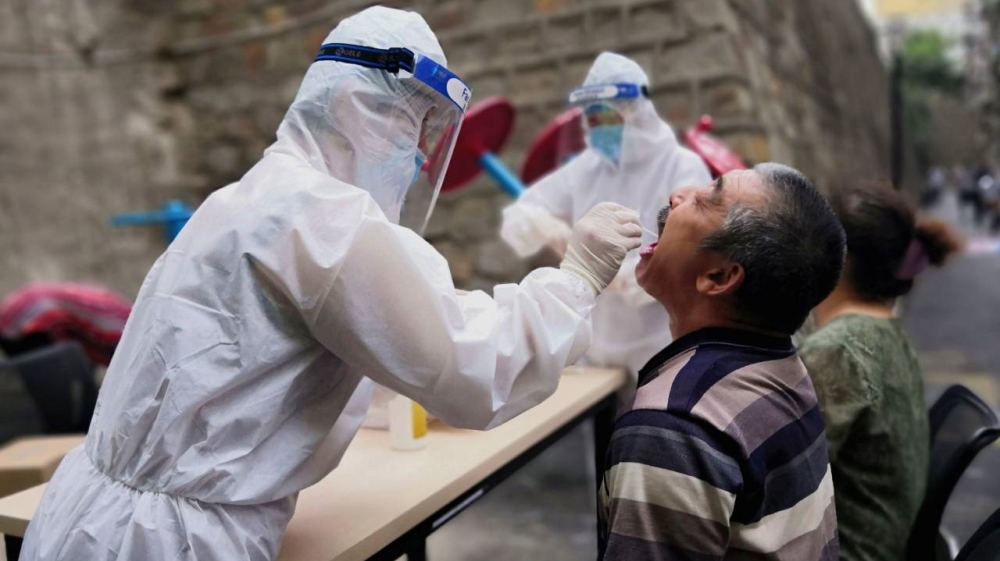 In China, 249 people remain in treatment [China Out/Reuters ] 02:40 GMT - Germany's confirmed cases rise by 249The number of confirmed coronavirus cases in Germany increased by 249 to 201,823, Reuters news agency reported on Monday quoting data from the Robert Koch Institute (RKI) for infectious diseases. The reported death toll rose by two to 9,086, the tally showed. 02:05 GMT - Despite COVID-19 infection, Bolsonaro greets supporters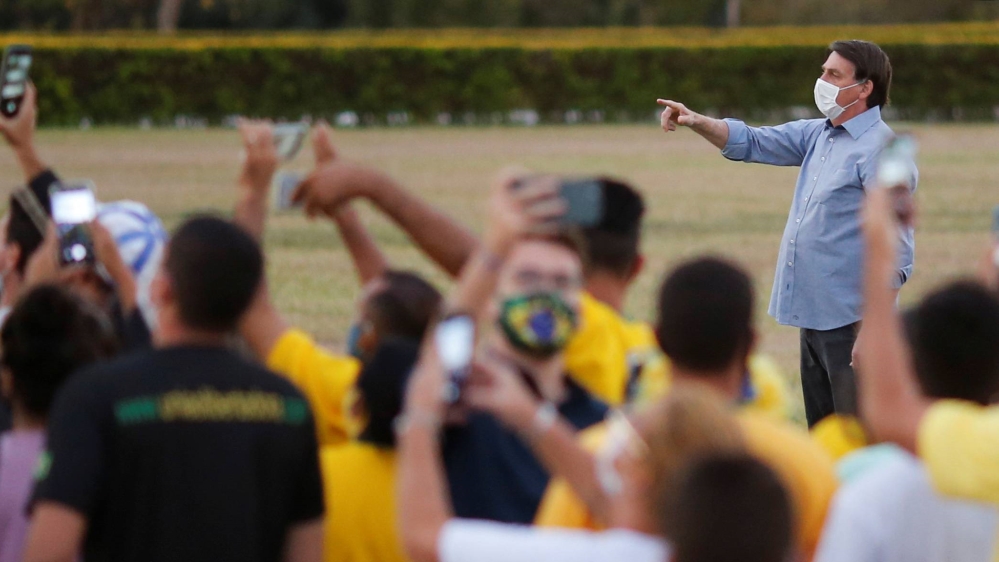 President Bolsonaro gestures while meeting supporters during a ceremony of lowering the national flag for the night, amid the coronavirus outbreak, at the Alvorada Palace in Brasilia, Brazil on Sunday [Adriano Machado/Reuters] Brazilian President Jair Bolsonaro ventured out of his official residence, Alvorada Palace, on Sunday to greet his supporters even as he recovers from COVID-19. Bolsonaro, who announced he tested positive for coronavirus on July 7, stepped out onto the grounds of official resident, walked towards a group of supporters, and spoke with them for about an hour. Wearing a mask, Bolsonaro said he is feeling well and again credited his health to the use of hydroxychloroquine to fight COVID-19, despite no scientific evidence. 01:50 GMT - Australia's Victoria state reports 275 new casesAustralia's second-most populous state of Victoria on Monday recorded one death from the new coronavirus and 275 new cases compared with 363 a day earlier, according to Reuters news agency. A woman in her 80s died from the virus overnight, Premier Daniel Andrews said in a briefing in Melbourne, taking the national death toll to 123. Coronavirus cases have spiked in Victoria in July, mostly in Melbourne, prompting authorities to ask residents to wear face masks when they step outside their houses or risk fines of 200 Australian dollars ($140) for not complying. 01:30 GMT - Imported cases still rising in South KoreaSouth Korea's imported coronavirus cases continue to rise by double-digit figures, according to the latest figures on Monday, even as new daily cases fell below 30 for the first time in more than three weeks. The country identified 26 new cases, raising the total caseload to 13,771, according to the Korea Centers for Disease Control and Prevention (KCDC). Of the newly added cases, just four were local infections, and 22 were imported. The country has seen double-digit numbers of imported cases for 25 consecutive days as of Monday, according to Yonhap news agency. One additional death was also reported, bringing the total death toll to 296. 01:00 GMT - El Salvador postpones economic reopening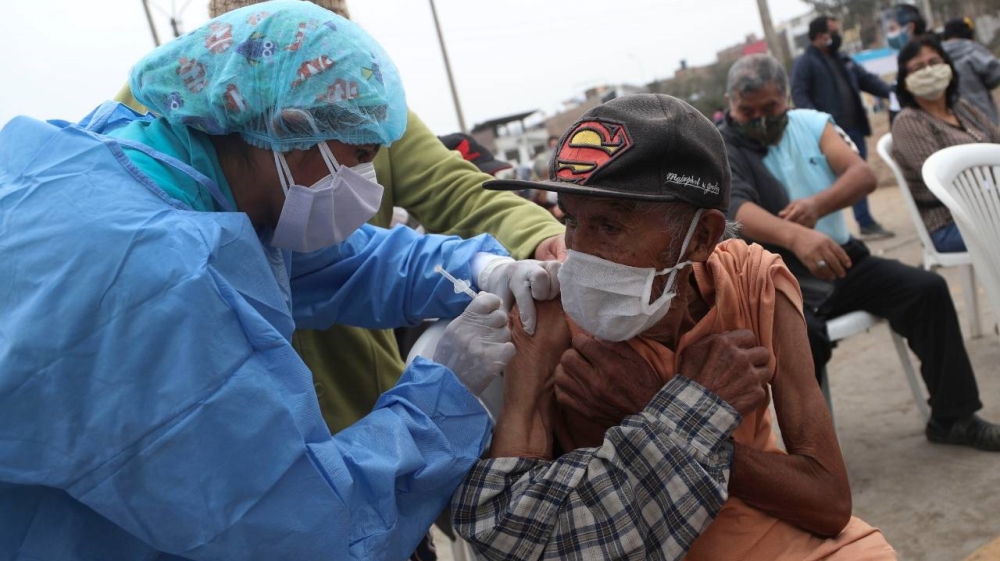 El Salvador has registered a total of 11,846 coronavirus cases and 335 deaths [File: Martin Mejia/AP] Salvadoran President Nayib Bukele has announced that he will postpone the second phase of the country's economic reopening, slated to begin on Tuesday, after evaluating inputs from experts and the Salvadoran health ministry, Reuters reported. "After listening to the opinions of experts and above all, the Ministry of Health ... I have decided to suspend Phase 2 of the economic reopening," Bukele wrote in a social media post on Sunday. El Salvador has registered a total of 11,846 coronavirus cases and 335 deaths. 00:30 GMT - Mexico reports 5,311 new cases, 296 more deathsMexico's health ministry reported 5,311 new confirmed coronavirus infections and 296 additional deaths, bringing the total in the country to 344,224 cases, including 39,184 deaths, according to Reuters. The government has said the real number of infected people is likely significantly higher than the confirmed cases. 00:12 GMT - Florida adds 12,000 new casesThe US state of Florida reported more than 12,000 new cases of COVID-19 on Sunday, the fifth day in a row the state has recorded more than 10,000 new infections, even as President Donald Trump pledged that "it's going to be under control". The virus has killed more than 140,000 people since the pandemic started, and Florida, California, and other Southern and Western states are creating new records every day, according to Reuters. "We have embers and we do have flames. Florida became more flame-like, but it's - it's going to be under control," Trump said in an interview with Fox News television channel. 00:01 GMT - Golf legend Jack Nicklaus reveals he had COVID-19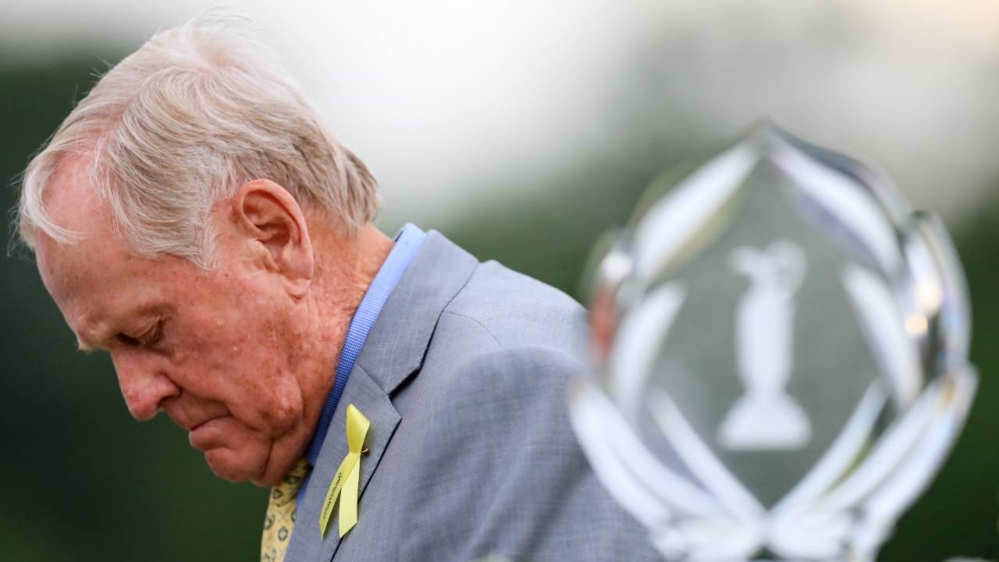 Nicklaus said his wife also contracted COVID-19 but did not have any symptoms, while he had a sore throat and a cough [Aaron Doster-USA TODAY Sports via Reuters] US golf legend Jack Nicklaus has revealed that he and his wife Barbara tested positive for the coronavirus at the onset of the pandemic, AP reported. They turned 80 a month apart at the start of the year. He said his wife had no COVID-19 symptoms, while he had a sore throat and a cough. Nicklaus said they were home in Florida from March 13 "until we were done with it" on about April 20. _______________________________________________________________ Hello and welcome to Al Jazeera's continuing coverage of the coronavirus pandemic. I'm Ted Regencia in Kuala Lumpur, Malaysia. You can find all the key developments from yesterday, July 19, here.  |
| You are subscribed to email updates from "usa news update" - Google News. To stop receiving these emails, you may unsubscribe now. | Email delivery powered by Google |
| Google, 1600 Amphitheatre Parkway, Mountain View, CA 94043, United States | |


Comments
Post a Comment